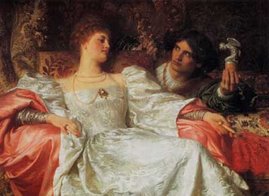
As part of my reading/writing program, I've been reading a number of paranormal romance novels published within the last 10 years. And, I've gleaned an important lesson from all this reading: Never sacrifice characterization to a glitzy concept. The best paranormal romances have strong characters with clearly defined goals and motivation, which then give rise to the conflict. In weaker paranormal romances, the characters seem like cardboard cutouts that are present simply to serve as props for the paranormal element(s).
Recently, I picked up a paranormal romance by a popular author because I was attracted by the concept of the book. When I finished the book, though, I felt that I really understood the world the author had created; however, I never fully understood the characters, which meant I couldn't buy into the conflict that was established between them. Still, the lesson above was reinforced: When I read romances, the characters have to be well-developed so that the conflict between/within the characters sustain the plot and keep me reading. I actually care about the characters and what's going to happen to them. If the author is too focused on some other element other than characterization, the novel's pacing suffers. Although I think witches, mythological creatures, and magic are very interesting in and of themselves, they aren't enough to keep me immersed in the book.
Having said all that, I don't always remember my own advice. So, I posted a little sticky note on my computer with the words, "It's the characters, stupid!" I hope it helps!
Showing posts with label characterization. Show all posts
Showing posts with label characterization. Show all posts
Thursday, May 31, 2007

Saturday, March 10, 2007
Writing Tips: Brainstorming
It's exciting to have a new idea for a story, but before you rush to the computer to jump into your draft, take some time brainstorming the plot and characters. These are examples of what have worked for me, and I'd be interested in hearing from other authors about their own writing methods. I have a different notebook devoted to each project, and I keep all my exercises in there. Before I begin any exercise, I like to start off with a little freewriting, where I write for 5-10 minutes and shake out any distracting ideas.

1. Characterization: First, work on the basic features of your characters. One useful tool is to develop a character chart that lists things such as appearance, birthdate, family members, etc. If you don't want to develop your own chart, The Ecletic Writer website has a "Fiction Writer's Character Chart" that you can use. I like to give each character her/his own page and leave some white space so I can add details in later. So, before you start the story, you'll have at least have a basic idea of who your characters are and what their motivation is.
2. Plotting: Next, develop an outline for the story. Some people have very detailed charts and graphs. When I first started, I tried listing all the chapters and then writing down plot elements for each one. Pretty soon, I was confused and discouraged, so I scrapped that method and now only use a basic synopsis. I figured I would have to write one eventually anyway, and it helped me to develop a basic organization for the plot.
3. Theme: What's the overall idea you want to convey in your work? "Love conquers all" or "dreams can come true" are good ones for a romance novel, but there are countless others you can use. Again, this is not set in stone, but knowing the main impression you want the reader to take away can help you during the drafting process.
Once my initial brainstorming is done, I'll type up the results of all my planning. I keep my character sheets and synopsis close at hand when I begin the drafting process, and it helps me to stay organized.
Next: The Drafting Process.

Subscribe to:
Posts (Atom)

 Posts